Planning a visit to Pompeii with kids was something I’d thought about carefully because I’d already been once before. Three years ago I visited with my husband on a romantic Amalfi Coast trip. We did a two-hour private tour, just the two of us, and I loved it but left feeling like we’d barely scratched the surface.
When my daughter started showing a real interest in ancient history, I knew Pompeii had to be part of our Italy trip. But I also knew that just repeating what we’d done as a couple wouldn’t work. Different kids, different ages, different attention spans, and some parts of a standard Pompeii tour that are simply not appropriate for children (like stories about brothels…).
Having done both visits, I can tell you: Pompeii with kids is not only possible, it can be one of the most memorable things you do in Italy. But the way you plan it matters enormously.
This guide covers everything — whether you need a guide, how long to spend, what to pack, age suitability, and the practical tips that will make your visit actually work with children in tow.
Is Pompeii Suitable for Kids?
Yes but it depends on the age and how you approach it.
For kids aged roughly 8 and up, Pompeii is fascinating. There’s enough visual drama with the preserved streets, the colourful wall paintings and the plaster casts of victims to capture their imagination without needing much background knowledge. Preteens and teenagers, especially those with any interest in history, often find it genuinely thrilling.
For younger children (under 7), it can be done, but manage your expectations. The terrain is uneven, there’s no shade, and two hours of ruins requires a certain attention span. With a good guide who knows how to engage little ones, it’s manageable. Just plan for a shorter visit and bring snacks.
Toddlers and strollers are a firm no. More on that below.
What Is Pompeii? (A Quick Explanation for the Kids)
Before we arrived, I gave the kids a brief overview and I’d encourage you to do the same.
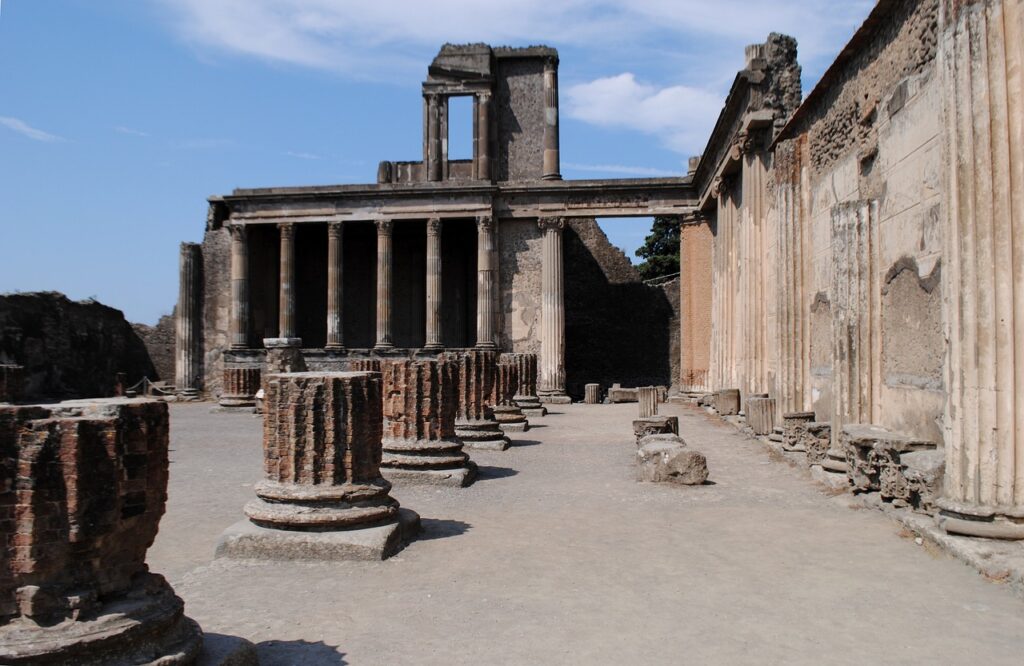
Pompeii was a thriving Roman city near modern-day Naples. In 79 AD, the nearby Mount Vesuvius erupted catastrophically, burying the entire city under metres of volcanic ash within hours. What makes Pompeii unique and what makes it so haunting is that the ash preserved everything almost exactly as it was. Streets, homes, bathhouses, bakeries, mosaics, even food in the ovens. It’s a near-perfect snapshot of Roman life frozen nearly 2,000 years ago.
That framing alone got my kids excited before we’d even arrived.
Do You Need a Guide at Pompeii with Kids?
Definitely yes. This is the single most important decision you’ll make about your Pompeii visit.
Pompeii covers around 170 acres. It is huge. And unlike most major historic sites, there are very few information signs throughout the ruins. Without context, you are essentially walking past walls, stones, and rubble without really understanding what any of it means. I’ve seen families wandering, looking vaguely puzzled, moving quickly from one area to the next because they don’t know what they’re looking at. That’s a wasted visit.
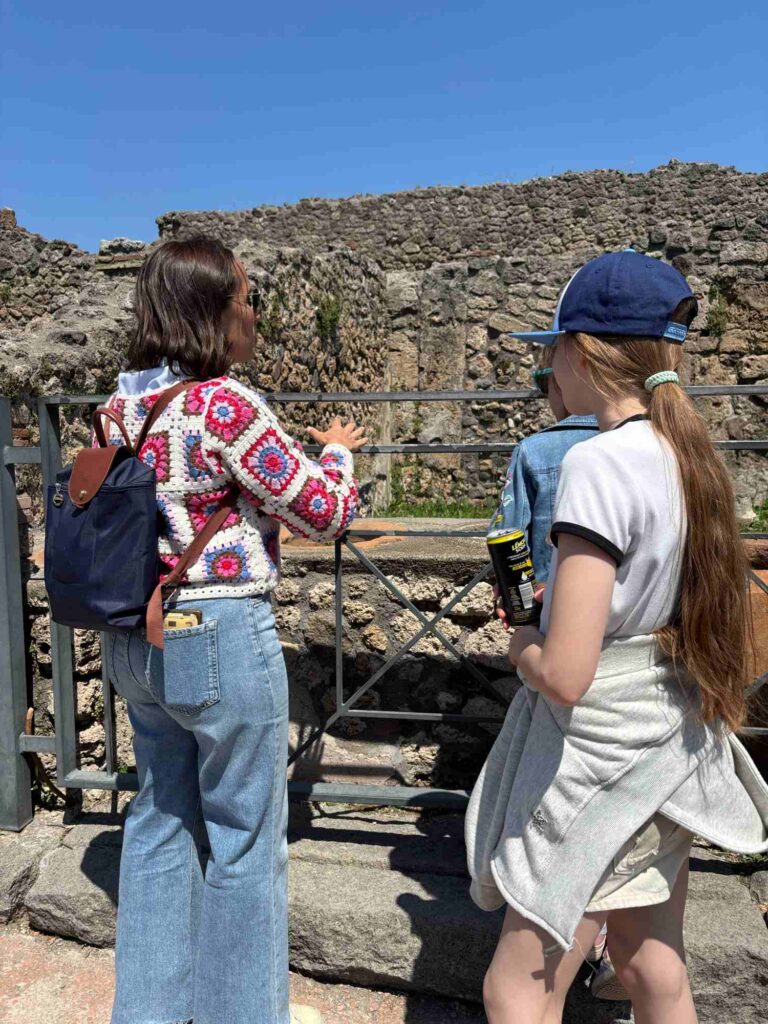
With a guide, everything shifts. Our guide brought the city to life through storytelling. She explained what daily life looked like, how families of different social classes lived side by side, where people worked, what they ate. Grand villas with intricate mosaics sit next to far simpler homes.
Do you need a family-specific guide, or will any private guide do?
Here’s my honest take: a dedicated family guide is ideal, but a private guide is what really matters.
When I was planning, I looked specifically for a family-friendly guide and I’d still recommend doing that first. But if you can’t find one, or they’re fully booked, don’t let that stop you booking a private tour. The key is that it’s private, because that’s what allows the whole experience to be tailored to your family.
Before the tour starts, just have a conversation with your guide. Tell them your kids’ ages, what they’re into, and what you’d prefer to skip. A good private guide will adjust entirely. The brothels, for example, are a well-known part of any standard Pompeii tour and perfectly interesting for adults but not something I wanted going into detail on with a 6 and 10 year old. On a group tour, you don’t get that choice. On a private tour, you just ask, and it’s done.
What I also didn’t expect was how relaxed the whole experience would feel as a result. I didn’t have to constantly check a map, figure out where we were going next, or worry about keeping up with a group. We just followed our guide. That ease made a bigger difference than I’d anticipated, especially with a younger child in tow.
We booked a three-hour private tour, and it was worth every cent. Our guide handled the tone beautifully — the kids understood the scale of what happened here, they were moved by it, but they weren’t distressed.
👉 Browse Private Pompeii tours on GetYourGuide.
What to See at Pompeii with Kids: Highlights from Our Visit
The Plaster Casts of Victims
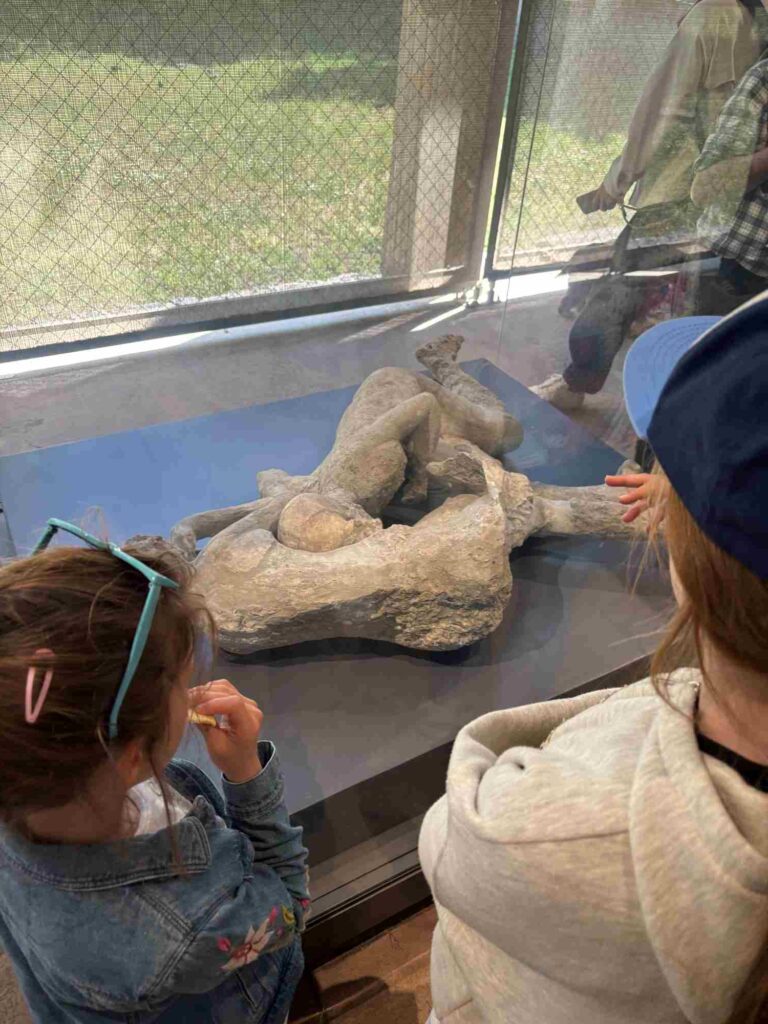
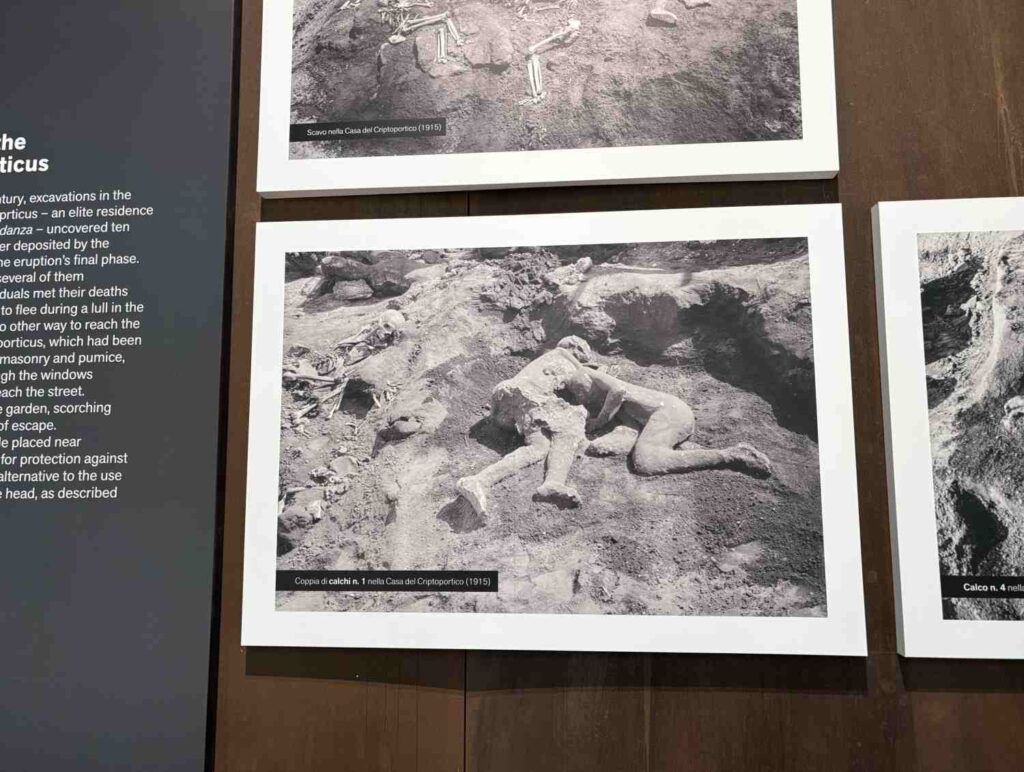
This was, without question, the most powerful part of the visit. Just three weeks before we arrived, a new exhibition opened in April 2026 displaying 22 of the approximately 100 plaster casts of victims discovered at Pompeii. What you see are the preserved final positions of people at the exact moment the eruption overtook them.
I was slightly worried about how the kids would react but they were not scared. What helped enormously was our guide taking the time to explain how these casts were made, not just what they are. The casting technique was developed at Pompeii itself in the 19th century — archaeologists discovered that the ash had hardened around the bodies, leaving hollow cavities. By filling those cavities with plaster, they could recreate the exact form of the person within. That explanation reframed the whole experience for the kids: this was also a story about the ingenuity of archaeology.
The Streets and Houses
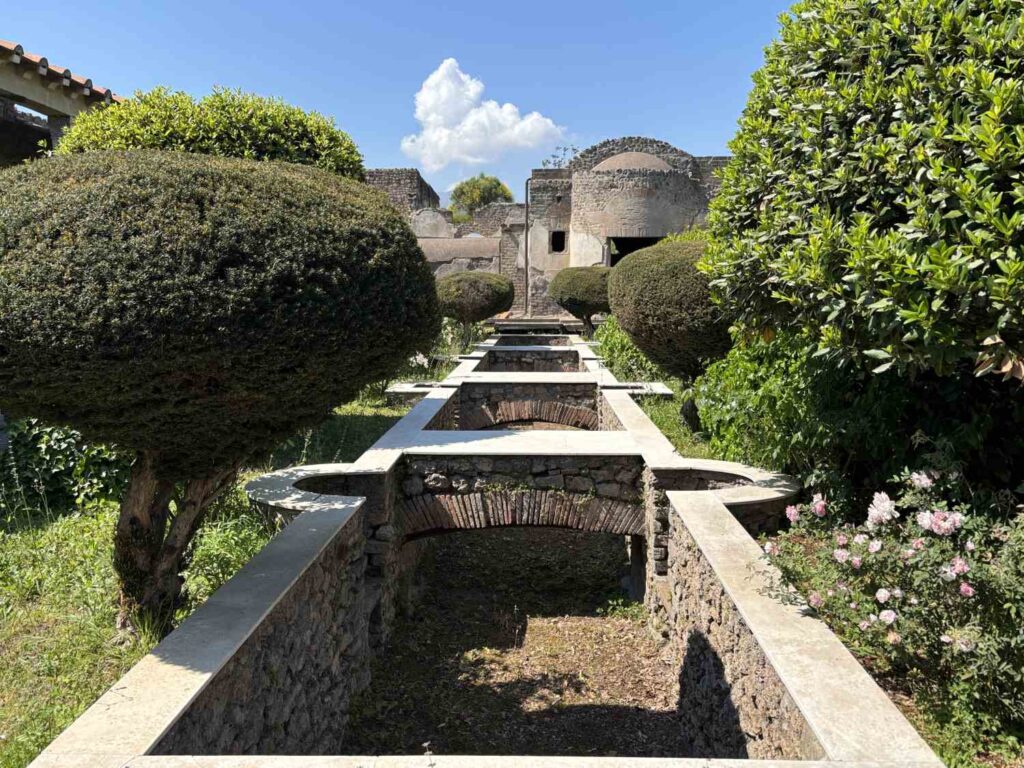
The preserved streets of Pompeii are extraordinary to walk. You can see the original stepping stones, raised so pedestrians could cross above street-level water and waste, and even the deep ruts carved into the stone by cart wheels over centuries. My kids thought the stepping stones were brilliant.
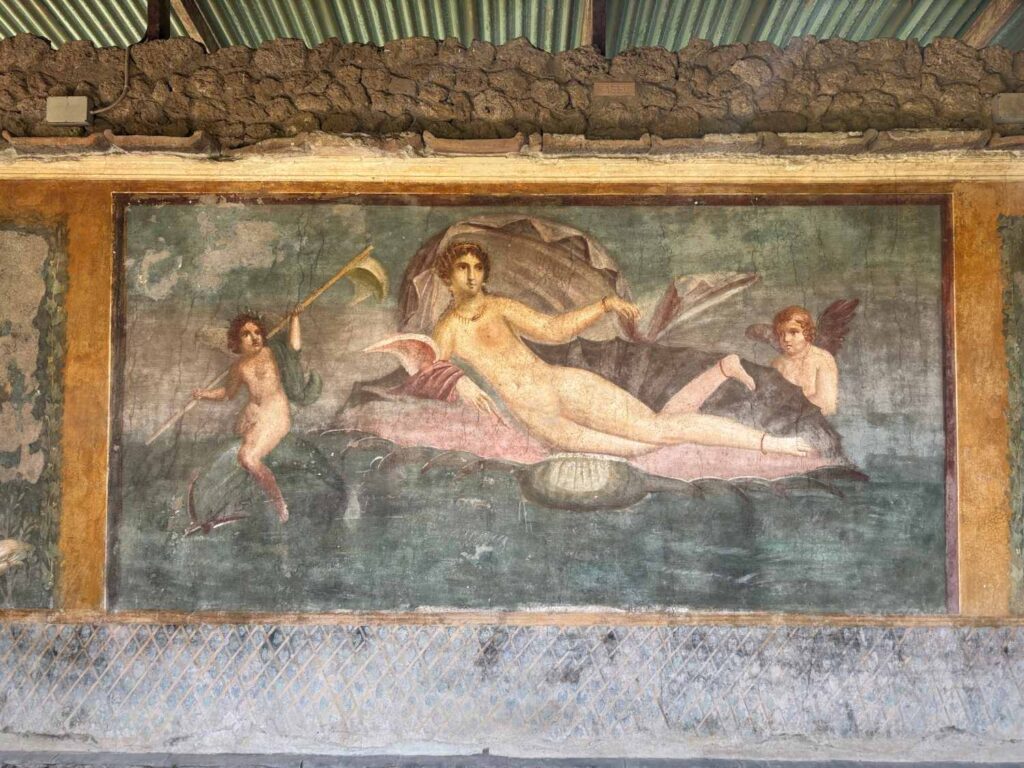
Some of the interior walls retain their original colours and paintings, and the kids spent a long time looking at these, trying to decode what scenes were depicted.
The Bakeries and Street Food Stalls
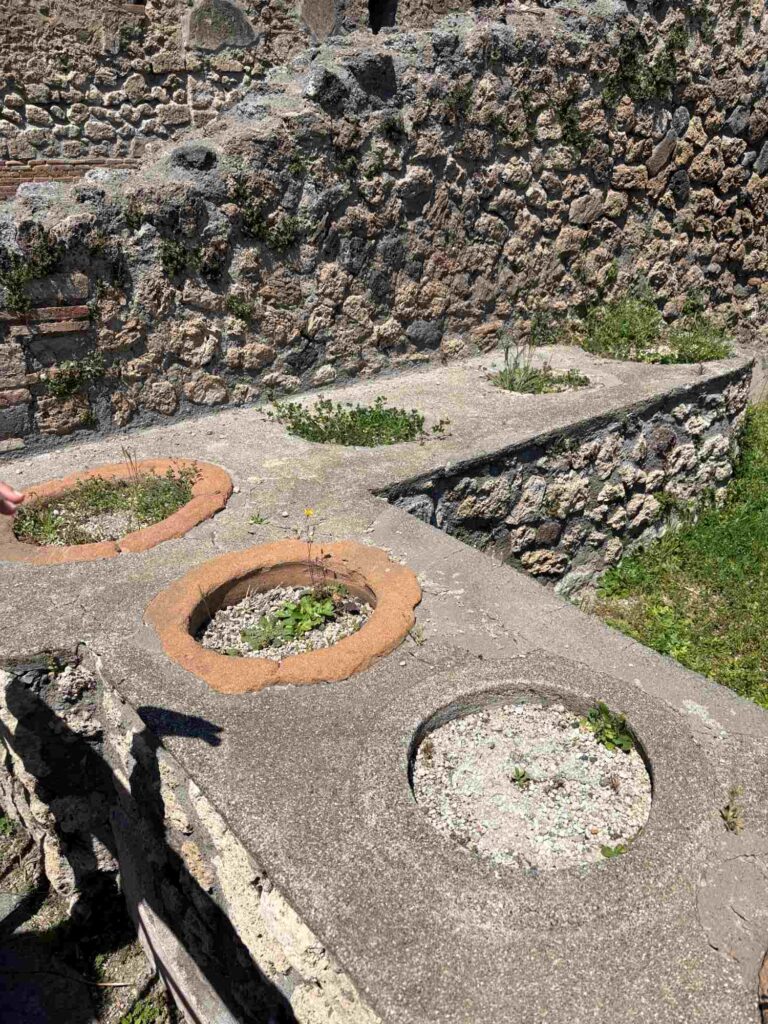
This was the section that got both kids equally excited. Our guide showed us the preserved bakeries — you can still see the large stone mills used to grind grain, and the domed ovens where bread was baked. But what really captured the kids’ imagination was the thermopolia — what our guide described as the fast food restaurants of ancient Rome. These were street-level counters where vendors sold hot food directly to people passing by, built right into the exterior walls of buildings. You can still see the holes in the stone counters where the large clay pots of food would have sat.
The Bathhouses
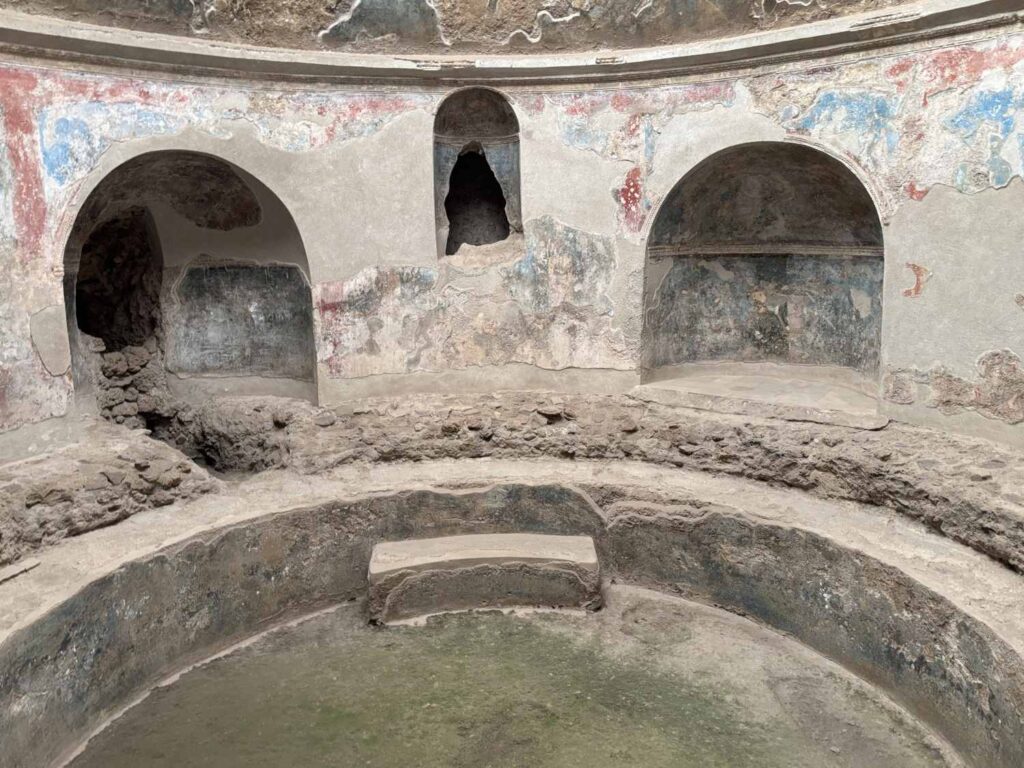
A genuine highlight — and the place where my kids asked the most questions of the entire visit. Our guide helped us visualise where the pool sat, how the underfloor heating system worked (hot air circulating beneath raised floors — the Romans called it a hypocaust), and how water was circulated through the building. The questions came thick and fast: how did they change the water? How hot did it get? If your kids are the type who ask “but how does it actually work?” about everything, the bathhouses will be their favourite stop.
Active Excavation Areas and Mosaic Restoration
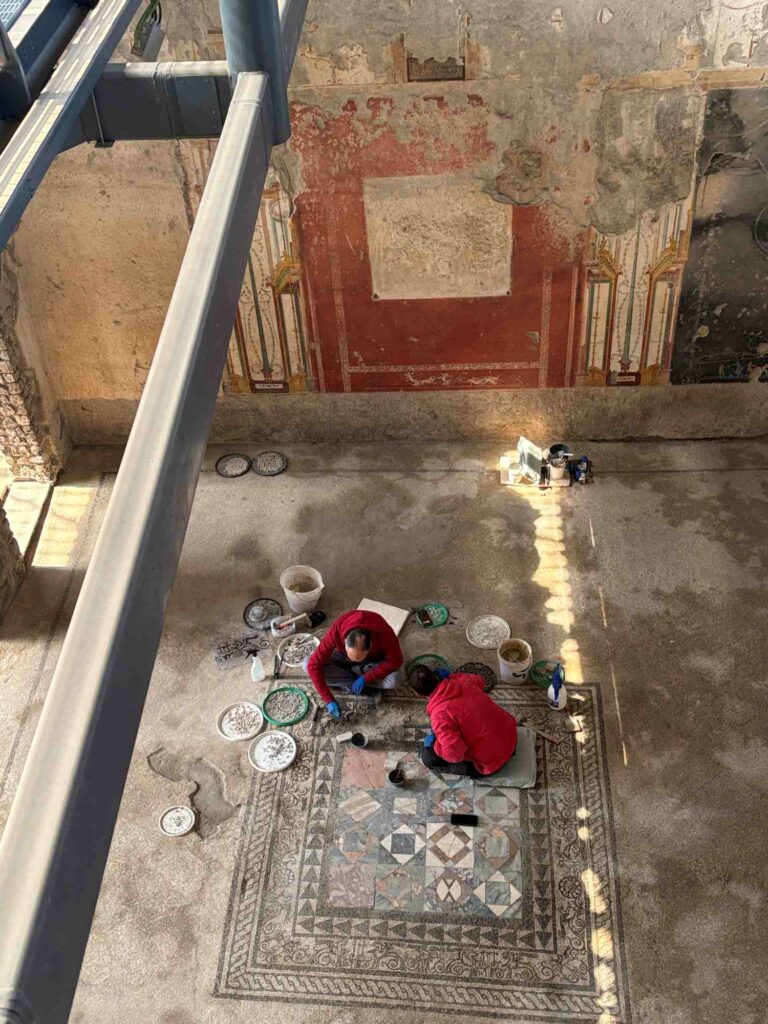
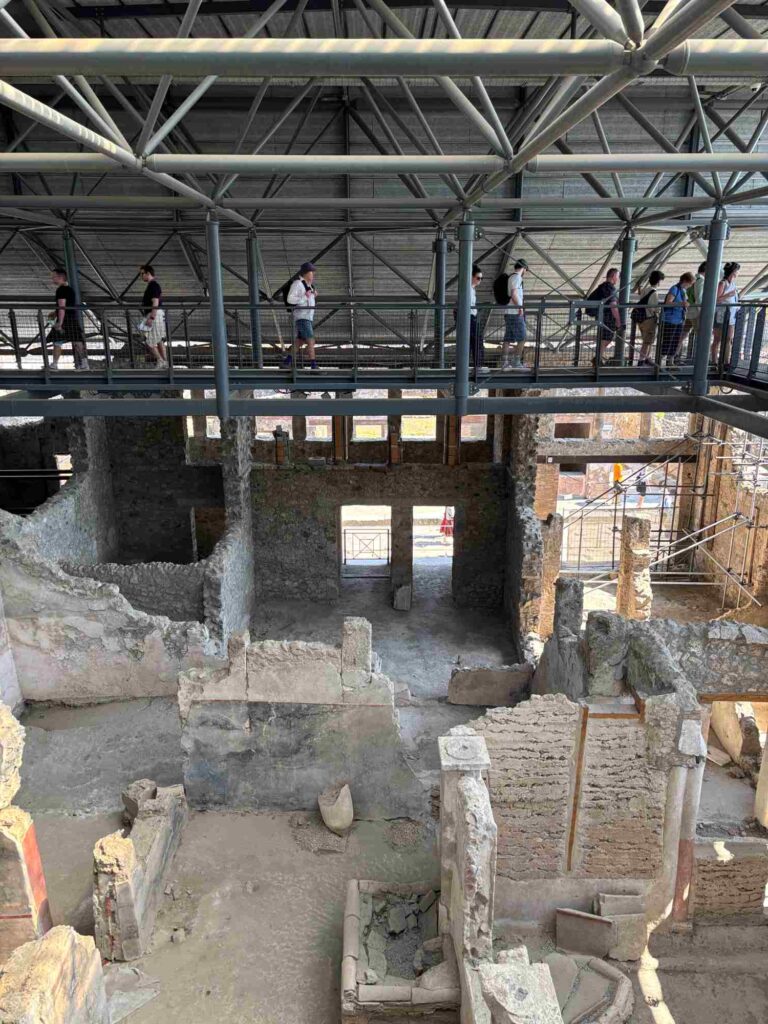
One of the most unexpected highlights was visiting areas where excavations are still ongoing and where restoration work is happening in real time. This section wasn’t even open on my previous visit three years ago.
We spent a long time here watching conservators carefully laying small broken tiles back into a floor mosaic, trying to reconstruct the original pattern piece by piece. My kids described it as one of the world’s most difficult jigsaws — thousands of tiny fragments, each needing to find its exact place in a design that’s nearly 2,000 years old. The kids were completely absorbed watching this.
It’s also a good reminder that Pompeii isn’t a finished story. A significant portion of the city is still buried, still being uncovered, still being pieced back together. That idea, that archaeologists are still finding things, genuinely thrilled both kids.
Practical Tips for Visiting Pompeii with Kids
1. Aim for 2–3 Hours
Pompeii is one of those places where you could spend an entire day. With kids, that’s rarely realistic or enjoyable for anyone. In our case, it was our 6-year-old who started to flag first, at around the two-hour mark. Our 10-year-old was fine and could have kept going, but we’d built some flexibility into the plan precisely because I knew this might happen. When we noticed energy dipping, we slowed the pace right down, found somewhere to sit, had some snacks, and let the little one just wander for a bit while the guide chatted more with the older one.
That flexibility is another reason a private guide is so valuable. A group tour would have kept moving regardless. We could adjust on the fly.
For most families, two to three hours is the sweet spot: enough to see a meaningful portion of Pompeii and actually understand what you’re looking at, without pushing past the point where it stops being enjoyable. If you have children under 7, build in that buffer and don’t try to see everything.
2. Book Tickets or Tour Guide in Advance
Do not turn up on the day and hope for the best. Pompeii is one of the most visited sites in Italy and queues at the ticket office can be very long, especially in summer. Book your tickets online in advance at the official Pompeii site. If you’re booking a guided tour, your tour provider will typically handle entry as part of the package (confirm this when booking).
3. Wear Flat Shoes — No Strollers
The ground inside Pompeii is ancient, uneven stone – this is original Roman paving with gaps and raised stepping stones. It is not friendly terrain.
- Flat, closed-toe shoes are essential for everyone, including kids
- Sandals are workable but not ideal
- Do not bring a stroller. It is genuinely not possible to navigate the site with one. Use a carrier for babies or toddlers, and be aware that this is physically demanding on the adult carrying them in the heat
4. Protect Against the Sun
Pompeii is almost entirely exposed. There is very little shade across the site, and on a warm day (which in southern Italy is most of the year) this becomes a real issue.
- Apply sunscreen before you enter (you can’t easily duck away to reapply)
- Pack hats for everyone
- Bring more water than you think you need
- If possible, avoid visiting in July and August, when temperatures regularly exceed 35°C. Late spring (April–May) and early autumn (September–October) are far more comfortable
5. Go Early in the Morning
The site opens at 9am. Aim to be there as close to opening as possible. You’ll beat the worst of the crowds, the light is beautiful for photos, and it’s cooler before midday. By 11am–12pm, tour groups begin arriving in volume and the main areas become noticeably busier.
6. Bring Snacks and a Picnic
Pack snacks, especially for younger kids who need to keep energy levels up. There are lots of cafes and restaurants near the entrance to the site so you can purchase something last minute there.
7. Brief the Kids Beforehand
Giving kids some explanation about Pompeii before you arrive makes a big difference. Explain what Mount Vesuvius did, and maybe watch a short YouTube video together. Kids who arrive with a little context are far more engaged from the start and ask much better questions.
8. Combine with Herculaneum if Time Allows
Herculaneum is a smaller, less-visited Roman city also destroyed in the 79 AD eruption. It’s located nearby and is, in some ways, even better preserved than Pompeii. If you’re spending a few days in the area, it’s absolutely worth adding. The smaller scale makes it slightly more manageable with kids. Doing both sites with younger kids would be way too much in one day but could be doable with teenagers.
Where to Stay When Visiting Pompeii with Kids
Most travel guides will suggest that you base yourself in Naples as it’s the closest city to Pompeii and, technically, the most practical. But honestly? I didn’t like Naples and wouldn’t recommend it as a base for a family trip, particularly if you’re travelling with kids.
Instead, I’d strongly suggest basing yourself somewhere on the Amalfi Coast. You get beautiful landscapes, stunning coastal towns to explore between day trips, and it’s far more enjoyable as a place to actually be. The tradeoff in travel time to Pompeii is minimal and the difference in experience as a base is enormous.
We stayed at Anna Belle Elegant Agriresort, perched on the cliffs overlooking Sorrento, which was beautiful. From Sorrento it couldn’t be easier to get to Pompeii — there’s a direct train from Sorrento station to Pompeii station, and the site is literally a couple of minutes walk from where you get off.
👉 Browse family hotels near Sorrento and the Amalfi Coast on Booking.com
Visiting Pompeii with kids turned out to be such a fantastic day trip. Book a private guide, go early, pack the sunscreen, and don’t stress about seeing everything. The bits you do see, you’ll remember.
Have a question about visiting Pompeii with kids? Drop it in the comments below — happy to help.
More Posts on Italy with Kids
Amalfi Coast with Kids: What Parents Need to Know – honest review on suitability for kids.
Florence with Kids: How We Spent 4 Days in the City – detailed itineraries and tips.
Venice with Kids: What to See, Do and Skip in 4 Days – detailed itineraries and tips.
Doing a Day Trip from Venice with Kids: Murano, Burano & Torcello – what’s different about the islands and which ones to visit.
Disclosure: This post contains affiliate links and I receive a commission if you visit a link and buy something on my recommendation. Purchasing via an affiliate link doesn’t cost you any extra, and I only recommend products and services I trust. All opinions are my own. For more details see my disclaimer and privacy policy.